








Transporting Wind Energy Components from the Port of Vancouver to Arlington, OR
Industry: Wind Power / Renewable Energy
Project Location: Arlington, OR / Port of Vancouver
Services Used: Specialized Transportation, Industrial Project Logistics
Equipment Used: Aspen and Temisko Double Schnabel Trailers
Project Type: Superload / Wind Energy Component Transport
Arlington, OR, is home to numerous wind farms, including the third largest in the United States. With a high demand for wind energy, new wind energy components are regularly required to outfit new and established wind farms in the area.
With limited labor available at the ports along the west coast, our client—an international transportation and logistics company—needed an experienced specialized transportation company to deliver 82 wind energy components from the Port of Vancouver to a distribution center in Arlington. Since the timeline to deliver was shrinking and a loss of production value was on the line, Omega Morgan’s Portland specialized transportation team stepped up to the plate to deliver a world-class solution.
The Challenge: Transporting 82 Wind Energy Components Under a Tight Deadline
Moving oversized wind energy components requires extensive preparation before the first load leaves the port. For this project, Omega Morgan needed to transport 82 components under a compressed schedule while navigating construction activity and permitting requirements.
The Solution: Specialized Transportation Planning to Keep a Renewable Energy Project Moving
Success depended on careful coordination between Omega Morgan, the port, construction crews, and state permitting agencies. Detailed planning allowed each load to move safely while keeping the project on schedule.
Once our client reached out to Omega Morgan to coordinate pickup and delivery dates and provide details of what the crew would be hauling, our team got to work. The 82 wind energy components included 41 tower bases—37’8” long by 15’ in diameter and a weight of 136,686 pounds—and 41 tower midsections—55’2” long by 13’9” in diameter and a weight of 137,789 pounds.
Superload Permitting in Washington and Oregon
Due to the short timeline for completion, the project manager immediately began securing superload permits for Washington and Oregon. Superload permits are required when the total weight of the transport configuration is over 200,000 pounds. These permit requests take around 30 days to complete, so timeliness was essential—and because the project start was delayed, the team had to continually update the superload permits in preparation for interstate state transportation.
Detailed Route Survey and Planning
Although Omega Morgan regularly operates between the Port of Vancouver and the destination distribution center, every oversized move requires its own route assessment. Our team surveyed the route to confirm all 82 loads could travel safely and efficiently from the port to Arlington.
Coordination Around Port Construction
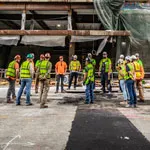
A large paving project outside the Port of Vancouver created an additional logistical challenge. Our project manager remained in constant communication with paving crews, contractors, and other carriers transporting wind cargo so each shipment could move around changing construction schedules without unnecessary delays.
Double Schnabel Trailer Transport
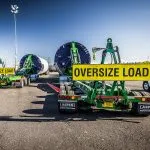
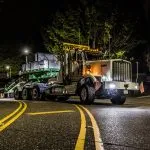
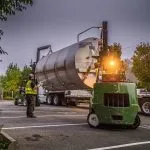
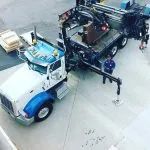
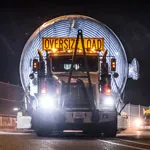
Omega Morgan transported every component using Aspen and Temisko double Schnabel trailers designed for oversized wind energy cargo. Running two to three trailers at a time kept loads moving steadily throughout the project.
The Transport Process: Heavy Hauling for Superloads
Finally, in early August, our crew prepared to load the first pair of components for delivery. Every move followed a carefully coordinated process, from loading components at the Port of Vancouver to staging them at the Arlington distribution center. Each step was designed to protect valuable cargo while maintaining project momentum.
Loading Wind Energy Components at the Port
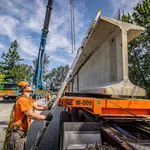
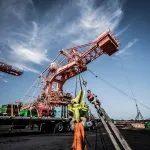
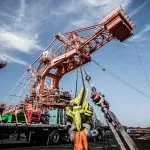
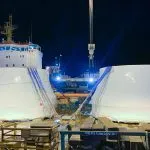
When the first loading day arrived, our crews arrived at the port with our Aspen and Temisko double Schnabel trailers. Each trailer required four crew members, including a driver, front pilot, steerman, and a rear pilot car. To load each component, the port workers stripped off the hardware from the transport ship and placed the component on the ground. Omega Morgan’s specialized transportation team then hooked the trailers to each end of the tube to lock it into place before raising the component off of its saddles. The port crew members would then remove the saddles and give the green light to roll out.
Transporting Oversized Components More Than 140 Miles
Each trailer transported one component approximately 140 miles from the Port of Vancouver to the Arlington distribution center. At any given time, two or three double Schnabel trailers were on the road, helping Omega Morgan complete all 82 deliveries in less than two months.
Offloading and Staging at the Distribution Center
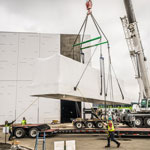
Once each load arrived, crews positioned the trailers while the distribution center team placed saddles beneath the component. After lowering the load onto the supports, the trailers disconnected and returned to the port to repeat the process until every component had been delivered.
The Results: Delivered Each Component Safely Without Construction Delays
Despite a compressed schedule and changing site conditions, Omega Morgan completed every delivery safely and on time. Careful planning, specialized transportation equipment, and close coordination helped keep the renewable energy project moving without sacrificing quality.
- 82 wind energy components delivered
- Project completed in under two months
- No loss in production value
- Components delivered in excellent condition
- Transportation completed without delaying construction
Image Gallery


